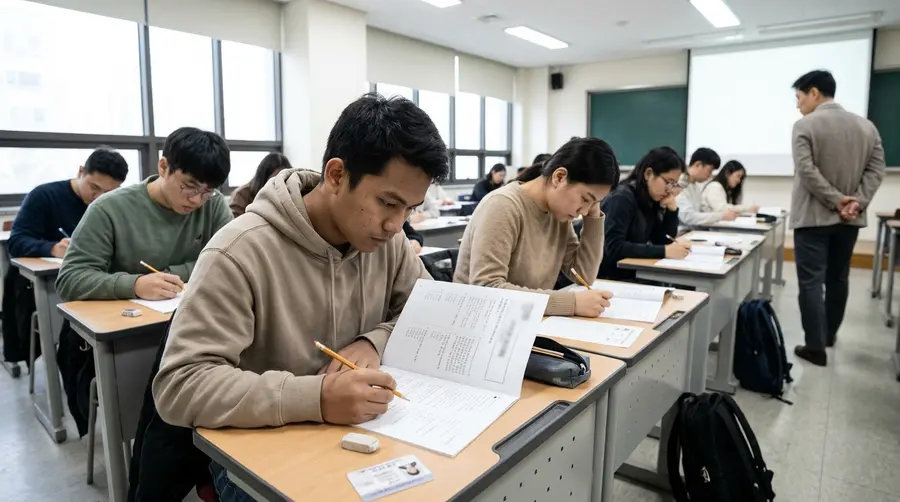
A rumor circulating among international students that “getting TOPIK Level 4 completely lifts restrictions on part-time work” has proved only half true. The core of the Republic of Korea Ministry of Justice’s plan to improve the student visa system is to simplify paperwork for part-time work and raise Korean-language requirements. The biggest practical benefit for students with TOPIK Level 4, it turns out, is not more hours on the job but an exemption from proving their financial capacity at the entry stage.
International student population tops 350,000 as government overhauls visas for a “400,000-student era”
The Ministry of Justice has overhauled the system based on the results of roughly five months of discussions by the “Consultative Council on Visa System Improvements for International Students,” which included experts in higher education, education and immigration. The changes aim to manage the rapidly growing student population systematically and help talented graduates settle in the country.
The number of international students in South Korea rose from 100,000 in 2016 to 200,000 in 2022 and 300,000 in 2025, surpassing 350,000 as of August 2026. The government is redesigning outdated rules in anticipation of an era with 400,000 international students.
Part-time work paperwork greatly simplified, but eligibility checks get tougher
Under the previous system, students seeking permission for part-time work had to gather and submit an extensive set of documents in person to an immigration office. These included an application, passport, alien registration card, part-time work confirmation, enrollment and transcript certificates, proof of Korean-language proficiency, a copy of the business registration certificate, a copy of the employer’s ID and a standard employment contract.
The plan streamlines these complicated approval requirements into two criteria: Korean-language proficiency and academic performance. Instead of submitting a stack of documents to the local immigration office, students will use a “Part-Time Work Confirmation” issued by their university and will be exempt from submitting other supporting documents. Administrative procedures have been simplified, but eligibility standards themselves have become stricter. Students with insufficient Korean-language skills will not qualify, regardless of the paperwork simplification.
An official from the Ministry of Justice said at a policy event on international students, “The Ministry of Justice’s policy puts the greatest emphasis on Korean-language proficiency.” The official made clear that Korean-language skills will also be a key factor, alongside length of stay and income, in the points-based assessment for transitions to F-2 (residency) and F-5 (permanent residency) status after obtaining a work visa.
Waiver of proof of funds of up to ₩20 million: the real value of TOPIK Level 4
The most consequential part of the changes is the exemption from proving financial capacity. Students who have TOPIK Level 4 or have completed Level 4 or higher of the Korea Immigration and Integration Program (KIIP) will not have to submit the financial documents that have been a major burden when applying for a student visa.
Under current rules, students in degree programs must prove they have a bank balance of about 20 million won (16 million won for regional universities), while language-program students must show 10 million won (8 million won for regional universities). For students whose visas have been denied for failing to meet these thresholds, or who have had to tie up family funds in an account for an extended period, TOPIK Level 4 is expected to be the most powerful solution.
Experts warn students to be wary of study-abroad agency ads touting “schools where it’s easy to work part time.” Programs that operate improperly, with classes held mostly on weekends, at night or online, are likely to be excluded from future visa incentives, putting students at risk of having their visa applications rejected even after they are admitted.
Five things current and prospective students should check now
To get ahead of the changes, current and prospective international students should review the following five items.
1. Check the difference in required levels: TOPIK Level 4 is the cutoff for employment eligibility for third- and fourth-year undergraduate students and graduate students. Even if a student in their second year currently has Level 3, Level 4 will be required as soon as they advance to their third year.
2. Check the TOPIK test schedule: Applicants living abroad should make sure they do not miss registration. The first tests open to overseas test-takers in 2027 are the 18th IBT session (held March 20, 2027, with registration in January) and the 111th PBT session (held April 10–11, 2027, with registration in January). Local registration periods vary by country and should be checked separately through notices from Korean Education Centers or embassies.
3. Consider taking KIIP as well: If it is difficult to secure a place in a TOPIK test, completing KIIP is an alternative. Under the revised plan, KIIP is recognized on the same basis for both the part-time work requirement (Level 3) and the financial-capacity exemption requirement (Level 4).
4. Check your university’s accreditation status: The additional five permitted work hours per week are available only to students at accredited universities. Students should check directly with their university’s international office whether their department remains eligible for visa incentives.
5. Keep up your grades: The minimum GPA for part-time work permission is 2.0 for the previous semester. Students who let their grades slip while working to support themselves could lose their work eligibility altogether.


댓글 (0)
댓글 작성
댓글을 작성하려면 로그인이 필요합니다.
로그인하기